Showing posts with label research. Show all posts

Preparing PhD Proposal Workshop

Bahagian Perkhidmatan Akademik, Perpustakaan Tun Abdul Razak, Universiti Teknologi MARA, Shah Alam is pleased to invite you to join the following workshop. Details of the coming workshop are as below:

PREPARING PhD PROPOSAL
Date: 9th December 2017 (Saturday)
Time: 8.00 am – 4.45 pm
Venue: Auditorium, Perpustakaan Undang-Undang, UiTM Shah Alam
Speaker: Professor.Dr.Norzaidi Bin Haji Mohd Daud
 Register now to book your seat!"

Strategies to Increase Your Citation Count

The American Journal Experts (AJE) proposes 10 easy ways how researchers can increase their citation count. (please go to www.aje.com to  source for other services)


1. Cite your past work when it is relevant to a new manuscript. However, do not reference every paper you have written just to increase your citation count.

2. Carefully choose your keywords. 
Choose 
keywords that researchers in your field will be searching for so that your paper will appear in a database search.


3. Use your keywords and phrases in your title and repeatedly in your abstract. 
Repeating keywords and phrases will increase the likelihood your paper will be at the top of a search engine list, making it more likely to be read.

4. Use a consistent form of your name on all of your papers. Using the same name on all of your papers will make it easier for others to find all of your published work. If your name is very common, consider getting a research identifier, such as
an 
ORCID or a ResearcherID. You can
provide your
ResearcherID in your email signature and link that ID to your publication list so that anyone you email has access to your publications.

5. Make sure that your information is
correct. 
Check that your name and affiliation are correct on the final proofs of your manuscript and check that the paper’s information is accurate in database searches.

6. Make your manuscript easily accessible.
If your paper is not published in an open-access journal, post your pre- or post-publication prints to a 
repository. Check SHERPA RoMEO to find your publisher’s copyright and self-archiving policies regarding sharing your published manuscript.

7. Share your data. 
There is some evidence that sharing your data can
 increase your citations. Consider posting to data sharing websites, such as figshare or SlideShare, or contributing to Wikipedia and providing links to your published manuscripts.

8. Present your work at conferences.
Although conference presentations are not cited by other others, this will make your research more visible to the academic and research communities.

9. Use social media.
Provide links to your papers on social media (e.g., 
FacebookTwitter, Academia.eduResearchGateMendeley) and your university profile page.
10. Actively promote your work. 
Talk to other researchers about your paper, even ones not in your field, and email copies of your paper to researchers who may be interested. Create a blog or a website dedicated to your research and share it.


Further details can be found on

https://www.aje.com/en/author-resources/articles/10-easy-ways-increase-your-citation-count-checklistSources:
http://journalauthors.tandf.co.uk/beyondpublication/optimizingcitations.asp
http://researchsupporthub.northampton.ac.uk/2013/02/05/2429/
http://www.jobs.ac.uk/careers-advice/working-in-higher-education/2172/how-to-increase-your-citation-rates-in-10-easy-steps-part-2/
http://mpra.ub.uni-muenchen.de/50919/

The Research in Malaysia online quiz


The Research in Malaysia online quiz is back! Join today
Facebook Twitter Linkedin
Wiley

With more challenges & more winners than
last year, do you have what it takes to
become one of our Champions for 2015?
How it works?

- Enter your particulars

- Successfully answer 8 questions correctly

- Two (2) optional bonus round for additional points

Prizes include:

- iPad Mini (WIFI) - 2 winners

- Portable Hard Drive (1TB) – 2 winners

- Coffee vouchers – 30 winners
Thank you! Because you’re a loyal subscriber of Wiley contents, you are already one step ahead. We’re giving you 1 extra point. Make sure to select “I received an email from Wiley” when asked how you found out about this activity.
START
Terms & conditions apply.
For enquiries, you may reach us at asiamktg@wiley.com
Wiley Online Library
Connect with Us!
Facebook facebook.com/Wiley.Online.Library Wiley Asia Blog wileyasiablog.com
Instagram instagram.com/wileyasiablog Twitter twitter.com/wileyasiablog
Linkedin linkd.in/AsiaHealth Google+ google.com/+WileyAsiaBlog
About WileyWiley is the international scientific, technical, medical, and scholarly publishing business of John Wiley & Sons, with strengths in every major academic and professional field and partnerships with many of the world's leading societies. Wiley publishes nearly 1,500 peer-reviewed journals and 1,500+ new books annually in print and online, as well as databases, major reference works and laboratory protocols.

192903

Bengkel "Boosting Your Research Experience with Web Of Science"


Perpustakaan Tun Abdul Razak (PTAR) dengan kerjasama Unit Impak dan Etika Penyelidikan,Research Management Centre (RMC)  menganjurkan ceramah bertajuk  "Boosting Your Research Experience With Web Of Science".Kursus akan dijalankan pada ketetapan berikut:

Sesi 1       

  Tajuk                    : Boosting your research experience with Web of Science
  Tarikh                   : 26 Ogos 2015
  Hari                      : Rabu
  Masa                    : 9.30 pagi - 12.00 tengahari
  Tempat                : Pusat IT, PTAR 1
  Penceramah       : Mr. Wilson Tan & Dr.See Diu Seng


Sesi 2

   Tajuk                  : Boosting your research experience with Web of Science
   Tarikh                 : 26 Ogos 2015
   Hari                     : Rabu
   Masa                   : 2.30 petang - 4.45 petang
   Tempat               : Pusat IT, PTAR 1
   Penceramah      : Mr. Wilson Tan & Dr.See Diu Seng


 Content            : - Basics of Web of Science.
                          - Parts of a manuscript 
                          - One-click referencing with Endnote 
                          - Impact factors: Does it impact you?
                          - An awesome cover letter worthy of your manuscript 
                          - You have submitted your manuscript. What’s next?


Sebarang pertanyaan sila hubungi:
Sekretariat UIEP, IRMI
Cik Fatimatun Nur
03-5544 8069
Email : fatimatun@salam.uitm.edu.my

Mendapatkan research topic overview di dalam handbook

Post kali ini menyentuh bahan yang boleh membantu anda mendapatkan research overview  yang lebih berfokus tentang topik anda. 

Sudahkah anda explore bahan ini?

Handbook – merupakan bahan rujukan yang memberi pencerahan tentang sesuatu bidang atau sebagai manual/panduan untuk sesuatu perkara.

Dapatkan handbook yang mengandungi ringkasan perkembangan penting penyelidikan dalam bidang yang anda pilih.  Bab-bab di dalamnya mengandungi synthesis hasil-hasil penulisan/dapatan penting bidang-bidang tertentu dan biasanya dihasilkan oleh pakar atau penyelidik dalam bidang tersebut.

Darinya anda akan mendapat maklumat tentang penyelidikan-penyelidikan yang telah dihasilkan dahulu, key person, dan tidak ketinggalan rujukan-rujukan yang boleh anda gunakan untuk pencarian seterusnya.

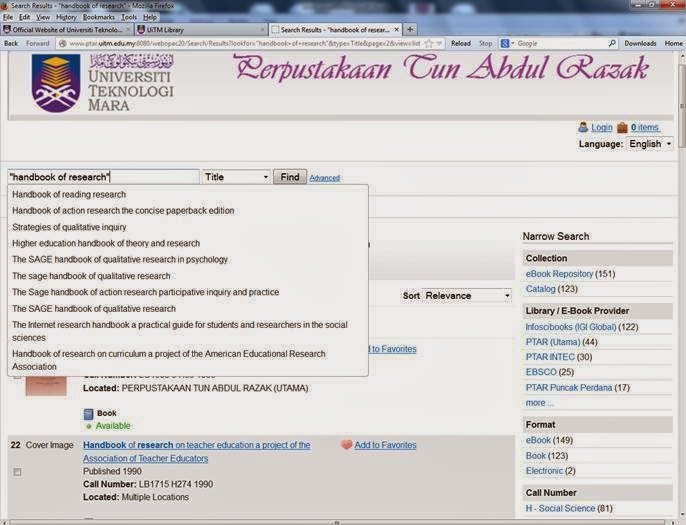
Cuba taipkan handbook of atau handbook of research di WebOPAC 2.0 PTAR ini, tukar field menjadi title dan klik find untuk mengetahui  judul handbook yang terdapat di PTAR 


Taip keyword seperti ini “handbook of research”, anda akan dapat 274 hits.  Jika anda buang tanda inverted commas “ dari keywords maka anda akan dapat 647 hits. 


Contoh handbook yang terdapat dalam koleksi PTAR, yang ini dalam versi buku elektronik. Klik Chapter PDFs via platform untuk mendapatkan bahan.


Untuk mudahkan anda memilih buku bercetak yang terdapat di PTAR seperti judul ini,  dapatkan review dari Amazon.com terlebih dahulu.  Contohnya ulasan untuk buku ini:

 “The International Handbook of Research on Conceptual Change consists of twenty-seven chapters that clarify the nature of conceptual change research, describes its most important findings and demonstrates their importance for education. It is organized into six sections that include detailed discussions of key theoretical and methodological issues, the roots of conceptual change research in the philosophy and history of science, mechanisms of conceptual change, and learner characteristics. It also contains chapters that describe conceptual change research in the content areas such as physics, astronomy, biology, medicine and health, and history.” (sumber review :  www.Amazon.com)

Semoga post ini membantu anda mencari  maklumat penyelidikan terdahulu (previous research) dalam bidang/topik anda. Berjumpa lagi nanti dengan sumber seterusnya, review articles,  untuk mencari perkembangan terkini penyelidikan dalam bidang/topik yang anda pilih.


Save your DATE with us!


Kini pelajar postgraduate dan juga penyelidik, boleh membuat Kelas Kemahiran Penyelidikan bersama pegawai-pegawai kami yang sedia membantu anda. Bagaimana caranya?

1) Isi borang tempahan di sini: Borang Tempahan Kelas
2) Jika tidak respond dalam 24jam, boleh emailkan butiran seperti nama, no.pelajar, fakulti, no.telefon ke researchjsp@gmail.com

JOM TRAINING.

ResearchSEA- Asia Research News portal (e-magazine)


ResearchSEA is Asia's first research news portal, a one-stop centre where journalists and members of the public can gain access to news and local experts from the research world in Asia.

Since 2005, ResearchSEA has been connecting research in Asia with the international media. For universities and research institutions, we promote new research findings and academic expertise to the media quickly and effectively. We can turn newsworthy papers into press releases, distribute those press releases to journalists all over the world and train researchers on how to deal with the media.


source: ResearchSEA website

What is MENDELEY?


Mendeley is a desktop and web program for managing and sharing research papers, discovering research data and collaborating online. It combines Mendeley Desktop, a PDF and reference management application (available for Windows, Mac and Linux) with Mendeley Web, an online social network for researchers. 

Mendeley requires the user to store all basic citation data on its servers - storing copies of documents is at the user's discretion. Upon registration, Mendeley provides the user with 2 GB of free web storage space, which is upgradeable at a cost. (source: Wikipedia)

Mendeley website: HERE

Survey: Research Commons


Komen atau cadangan boleh dilontarkan didalam ruangan kotak komen 
dibawah ini. Terima kasih.

Literature review made easy


The pen is mightier than the sword but to many, writing is difficult.  Researchers lament that running experiment in labs is peanuts but reporting is hard.   However, believing to first attain skills, creativity comes later, Dr Teoh Sian Hoon of the Faculty of Education, has created an Integrative Literature Review Software to assist academics and students to write the literature reviews of their research.

Though important, reviewing an article or synthesizing a model is unfortunately not as tangible and clear-cut as a research design.  Hence many encounter difficulties in writing a comprehensive literature review and synthesizing a conceptual framework.   Unlike a literature review, a research design has a concrete outline of the method of data collection and data analysis, thus this forces university students to attend courses on writing it.

Although most university students attend training session to write research paper during their studies,  Teoh  said, despite the training, writing a good literature review still poses major challenge to most of us.
 
Teoh’s survey on university students’ description and understanding on literature review revealed that the supervisors of postgraduates need to accept literature reviews as a problem area for students. She noted there is a need to develop strategies and tools to help the students have a clear picture on writing.

read more: RMI website

Engineering Research: from the Ivory Tower Reaching out to the Disabled Community


Engineering is often envisaged as the branch of knowledge connected to maths and sciences to solve real-world problems. In most parts of the world, any person who wishes to practice as an engineer must first successfully complete an accredited degree in engineering. Therein lays the path to pursue postgraduate study to individuals who wish to reach the highest levels of his or her capabilities. Such pursuit relies greatly on the opportunities and the wealth of researches that are accessible in the institutions of higher learning. 

Undeniably, on-going research is the beating pulse of the university. It is the catalyst to the number of grants acquiredfrom the government and private sector; and of course the ‘magnet’ that draws postgraduate students to the particular university. Despite all this, the research in engineering needs to be motivated by the ‘values’ it carries into the society. Then only the gap between the academia (often termed as the ‘ivory tower’) and the community can be bridged together.

Robotics is a branch of engineering that involves the operations and applications of robot technology. The research trend in this area is experiencing a paradigm shift from industrial robots towards socially assistive robotics and human-friendly robots. 

Rehabilitation robotics is part of the notion for robots to play substantial role in healthcare and specific rehab interventions for the elderly people and persons affected by neurodevelopmental disorders such as Cerebral Palsy (CP) and Autism Spectrum Disorders (ASD). With robotic intervention, it is hoped that the quality of life for the disabled can be made better and they may gain more independence in their daily lives.

read more: RMI website

(Re-post) Round table Flood Control Research Centre


Pada 16 Januari 2013 yang lalu, satu Simposium “International Flood Control Symposium (IFC 2013)” telah diadakan di Shah Alam, Ia yang melibatkan kerjasama dari 5 buah universiti dan pusat penyelidikan terkemuka iaitu  Universitat Stuttgart, Colorado State University, Asian Institute of Technology, Indian Institute of Technology Roorkee, UiTM, Institut Penyelidikan Hidrolik Malaysia serta Jabatan Pengairan dan Saliran, Malaysia.


Simposium ini adalah untuk membincangkan kaedah terbaik dalam pengawasan, pengawalan dan tindakan secara berkesan bagi sebaran maklumat banjir antara para jurutera, saintis, akademia dan pihak industri. Hasil gabungan 5 buah universiti dan juga badan profesional ini, “Flood Control Research Center” yang berpusat di UiTM akan ditubuhkan tidak lama lagi.


Susulan daripada itu satu Perbincangan Meja Bulat  bagi penubuhan "Flood Control Research Center" yang melibatkan Dato Sri VC UiTM, Prof Daniel Gunaratnam (Washington DC), Pierre Julien (CSU), Muthiah Perumal (IIT), Mukand Singh Babel (AIT) serta dekan dan beberapa pensyarah telah diadakan pada 17 Januari 2013 dimana Perpustakaan Tun Abdul Razak UiTM Shah Alam  turut memberi sumbangan dengan cadangan pengwujudan "Flood Control Research Center Library"  


Original post: Perpustakaan UiTM blog

INFO SHARING@PTAR - Library Connect Newsletter 10:3 - Information Literacy (Part 1)


Library Connect Newsletter keluaran November 2012 memaparkan amalan literasi maklumat di beberapa organisasi terpilih dari aspek mengenalpasti keperluan pengguna, pemantapan program dan pengenalan kepada teknologi baru. Teks penuh artikel tersebut boleh dirujuk dengan melayari pautan berikut:-

Picture: Google

1) The constant evolution of information literacy
By Janice Chia, Head of Instructional Services, Nanyang Technological University

2) Innovation partnering: Insert yourself into your community of users
By Sandra Crumlish, Manager, St. Jude Medical CRMD Library & Resource Center

3) Empowering best evidence use at the point of care
By Jonathan Koffel, Clinical Information Librarian, University of Minnesota Bio-Medical Library


4) Information literacy involves learning to use the right sources: Chemists look to Reaxys
By Dr. P. Srihari, Senior Scientist, CSIR-Indian Institute of Chemical Technology


Untuk membaca lain-lain artikel teks penuh Library Connect Newsletter 10:3 (Part 1) sila layari pautan ini, sumber: Library Connect (2012). Retrieved 29 Oct 2012, from http://mail.elsevier-alerts.com

Program anjuran Perpustakaan Abdul Razak dan Research Management Institute


Perpustakaan Tun Abdul Razak dan Research Management Institute (RMI) bakal mengadakan 2 program pada bulan November. Maklumat program seperti dibawah;

SAGE - "How to Publish an Article"
Date: 1st November 2012 (Thursday)
Time: 9:30am - 11.00am
Venue: Auditorium, PTAR 2, UiTM Shah Alam
 

Topic: "Guide to Writing a Journal Article wherein we provide a checklist of common errors made, how to select a journal to submit the article and a brief framework of a typical journal article."
 

Participant: 100 participates ( post-graduates, lecturers and Librarians)
Speaker: Rosalia da Garcia, SAGE.


Want print Tentative program? click HERE


Want print Rosalia Biography? click HERE


How to write a great research paper, and get it accepted by a good journal
Date: 20th November 2012 ( Tuesday)
Time: 9.00 a.m- 1.00 pm
Venue: Auditorium, PTAR 2.
 

Participants: 100 participates ( post-graduates and Lecturers)
 

Speaker: Dr Anthony Newman, in the field of Biochemistry & Clinical Chemistry, Elsevier Journal Publishers
 

Major sections of the presentation:
- What steps do I need to take before I write my paper
- Using Scopus to evaluate journals, authors and collaborators
- How can I ensure I am using proper manuscript Language
- How do I build up my article properly
- Author Responsibilities & Rights 


To ENTER please register to: UiTM Academic Publishing Workshop

Sebarang pertanyaan mengenai perkara di atas, boleh menghubungi Puan Siti Rohayu Bt Mohd Yusof di talian 03-55211701 atau Encik Shahrol Nizam Bin Johol di talian 03-55211707. Kerjasama dan keprihatinan dalam perkara ini didahului dengan ucapan terima kasih.

FRIM works with UiTM on its research plot survey

 
3 February 2012 (Friday) – The Forest Research Institute Malaysia (FRIM) has launched a joint survey programme with Universiti Teknologi Mara (UiTM) to compile crucial data and produce a precise map of all its research plots.

The launching of the FRIM Research Plot Survey and Inventory Programme, held on 1 February at the Sungai Kroh picnic area in FRIM, Kepong, was officiated by FRIM Director General (DG) Dato’ Dr Abd Latif Mohmod.


Under this programme, FRIM researchers and 50 students including their three technical supervisors from the UiTM Department of Surveying Science and Geomatics will conduct the field survey in FRIM for a month until the end of February.

For the students, the programme forms part of their technical training activities during semester break. The main output of the exercise will be the precise map of all FRIM research plots established as early as 1920s that have never been properly surveyed before.

Source:  FRIM website

How Research Can Investigate Psychotherapy

Now to the question I have been building up to: If, for some of us, this is the nature of psychotherapy, then how can research investigate and measure it? I think that it is beginning to be investigated in two ways: first, in physiological terms, and secondly, in terms of increasingly refined observations of tape-recorded in-therapy behavior.


I want to say a few words about each of these.


Psychophysiological studies have been reported (Berlin, 1960; Matarazzo, 1958) showing that different interpersonal conditions involve different autonomic correlates. We have currently also made a start (Gendlin, 1961 c) at finding autonomic correlates of different manners of experiencing (as defined in the Process Scale) and of resulting changes.


Another line of researches shows that psychotic contents can be produced in the laboratory by inhibiting the normal interaction of person or body, as happens in dreams, hypnosis, and laboratory stimulus isolation. Psychotic contents seem to appear when stimuli for optimal interaction are reduced. Also, LSD, Carbon Dioxide, and other toxics produce them. I think it is likely that we will find, also, physical modes of restoring, rather than inhibiting, optimal organismic process, and optimal interaction.


Currently, it is true, society seems more to want to tranquilize its schizophrenics — and itself — so as to avoid, rather than restore, personal interaction and optimal physical interaction. Yet, I think physical and psychological avenues of research are increasingly defining one optimal process of organismic life, physical, subjective, and interpersonal.


[read more: HERE]

FREE installation EndNote at Hari Mesra PTAR 3 & 4


For  "Hari Mesra PTAR" at Science and Technology (S&T). There will be a booth from Research Support Department . This is our  effort to meet users face -to-face outside PTAR1.


Our services includes:
1. FREE installation of EndNotes version X3

2. Q and A about Scholarly Research services, ISI Thomson, Scopus.
Please join us there , or call us at 03-55435770. Thank you


** ISI Web of Knowledge banner

** FREE installation EndNotes

** BPM department


** Lots of student interested with our booth!! =D


See you there! Today is last day we at S&T foyer