Showing posts with label web of science. Show all posts

Web Of Science Discovery Quiz 2018


Web of Science Discovery Quiz 2018

Discover the power of Web of Science by joining this quiz and you might just win fabulous!

Web of Science Usage Awards & Discovery Quiz 2015


Thomson Reuters is pleased to announce the launch of the Web of Science Usage Awards and Discovery Quiz from 1 October till 31 December 2015.  We look forward to working with you to drive campus usage for Web of Science.
Librarians, faculty members and students will get a chance to win fabulous prizes* just by participating in this game.

This year, there are four categories for the Usage Awards and they are:

Research University
  • Top Usage Award
  • Top Usage Growth Award
Non-Research University
  • Top Usage Award
  • Top Usage Growth Award
To find out more about the mechanics of the Usage Awards and the exact quiz dates which will run from 01 October 2015 to 31 December 2015, simply click the link below:


http://images.info.science.thomsonreuters.biz/Web/ThomsonReutersScience/%7B058a0962-18e5-4d04-8d0b-2c2c48195557%7D_WoS_Usage_Campaign_MY_2015_-_For_Library.pdf


For more information, please do not hesitate to contact Mr Denys Ho from Thomson Reuters at +65 6870 3594 or denys.ho@thomsonreuters.com.

We look forward to your participation!

Bengkel "Boosting Your Research Experience with Web Of Science"


Perpustakaan Tun Abdul Razak (PTAR) dengan kerjasama Unit Impak dan Etika Penyelidikan,Research Management Centre (RMC)  menganjurkan ceramah bertajuk  "Boosting Your Research Experience With Web Of Science".Kursus akan dijalankan pada ketetapan berikut:

Sesi 1       

  Tajuk                    : Boosting your research experience with Web of Science
  Tarikh                   : 26 Ogos 2015
  Hari                      : Rabu
  Masa                    : 9.30 pagi - 12.00 tengahari
  Tempat                : Pusat IT, PTAR 1
  Penceramah       : Mr. Wilson Tan & Dr.See Diu Seng


Sesi 2

   Tajuk                  : Boosting your research experience with Web of Science
   Tarikh                 : 26 Ogos 2015
   Hari                     : Rabu
   Masa                   : 2.30 petang - 4.45 petang
   Tempat               : Pusat IT, PTAR 1
   Penceramah      : Mr. Wilson Tan & Dr.See Diu Seng


 Content            : - Basics of Web of Science.
                          - Parts of a manuscript 
                          - One-click referencing with Endnote 
                          - Impact factors: Does it impact you?
                          - An awesome cover letter worthy of your manuscript 
                          - You have submitted your manuscript. What’s next?


Sebarang pertanyaan sila hubungi:
Sekretariat UIEP, IRMI
Cik Fatimatun Nur
03-5544 8069
Email : fatimatun@salam.uitm.edu.my

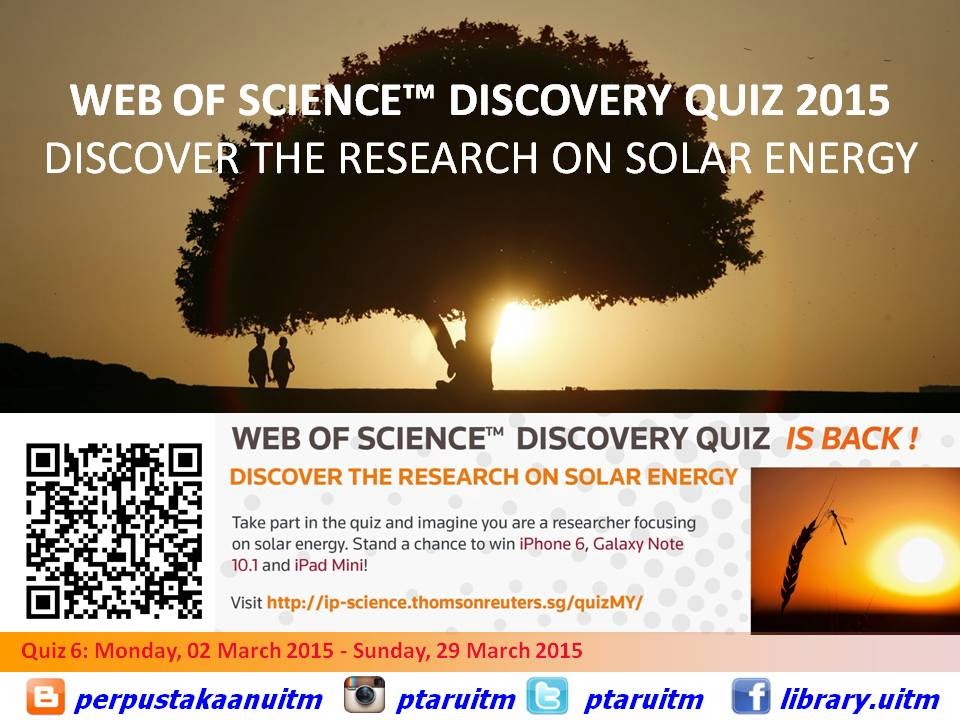
WEB OF SCIENCE DISCOVERY QUIZ MARCH 2015


Every hour the sun beams onto Earth more than enough energy to satisfy global energy needs for an entire year. Solar energy is the technology used to harness the sun's energy and make it useable.

It is predicted that by 2025 solar will be the largest source of energy on the planet.

Thanks to improvements in photovoltaic technology, chemical bonding, photocatalysts and three-dimensional nanoscale heterojunctions, the use of the sun as the world’s primary source of energy will be no longer be for the environmentally conscious; it can be made more accessible to the masses.

Would you like to know more?
Take part in the Web of Science™ Discovery Quiz and imagine you are a researcher focusing on solar energy. What’s more, you stand a chance to win fabulous prizes. (cont)

Quiz Dates

Quiz 6: Monday, 02 March 2015 - Sunday, 29 March 2015

 
There will be monthly quiz winners. Individual with the highest number of correct answers for each quiz will win Thomson Reuters KeepCup. Five KeepCups will be given away for each quiz!


REGISTER HERE:


Web of Science™ Discovery Quiz: Discover the research on Solar Energy


Every hour the sun beams onto Earth more than enough energy to satisfy global energy needs for an entire year. Solar energy is the technology used to harness the sun's energy and make it useable.

It is predicted that by 2025 solar will be the largest source of energy on the planet.

Thanks to improvements in photovoltaic technology, chemical bonding, photocatalysts and three-dimensional nanoscale heterojunctions, the use of the sun as the world’s primary source of energy will be no longer be for the environmentally conscious; it can be made more accessible to the masses.

Would you like to know more?
Take part in the Web of Science™ Discovery Quiz and imagine you are a researcher focusing on solar energy. What’s more, you stand a chance to win fabulous prizes. (cont)

Quiz Dates
Quiz 1: Monday, 06 October 2014 – Sunday, 02 November 2014
Quiz 2: Monday, 03 November 2014 – Sunday, 30 November 2014
Quiz 3: Monday, 01 December 2104 – Sunday, 04 January 2015
Quiz 4: Monday, 05 January 2015 - Sunday, 01 February 2015
Quiz 5: Monday, 02 February 2015 - Sunday, 01 March 2015
Quiz 6: Monday, 02 March 2015 - Sunday, 29 March 2015

 
There will be monthly quiz winners. Individual with the highest number of correct answers for each quiz will win Thomson Reuters KeepCup. Five KeepCups will be given away for each quiz!


REGISTER HERE:


Program Thomson Reuters Web Of Science & Endnote


Bahagian Perkhidmatan Akademik (BPA), Perpustakaan Tun Abdul Razak (PTAR) Utama dengan kerjasama Research Management Institute (RMI) ingin mengucapkan jutaan terima kasih kepada semua yang terlibat dalam menjayakan program bertajuk THOMSON REUTERS WEB OF SCIENCE & ENDNOTE TRAINING pada 29 Ogos 2014 (Jumaat) dari 9.30 hingga 4.30 petang di Pusat IT , Perpustakaan Tun Abdul Razak (PTAR) 1

Program ini telah dihadiri seramai 50 perserta yanda terdiri dari 35 orang Pensyarah  , 10 orang pelajar Pasca iswazah  dan selebihnya Pustakawan

Semoga ilmu dan pengetahuan dapat dijadikan manfaat untuk kita sama-sama meningkatkan lagi mutu penyelidikan dan perkhidmatan perpustakaan. Harapan pihak kami agar kursus seperti ini dapat dianjurkan lagi di masa-masa akan datang. 

Terima kasih atas sokongan dan maklumbalas daripada para peserta dan para jemputan. Mohon maaf diatas segala kesulitan mahupun kekurangan sepanjang kursus ini dijalankan. Pihak kami akan membuat penambahbaikan untuk kursus-kursus di masa akan datang.

Bersama ini disertakan slide persembahan yang telah diberikan kebenaran oleh Wilson dari Thomson Reuters untuk dikongsikan;


Link: Web Of Science training note

Foto sekitar majlis berlangsung;


Sumber: Info PTAR blog  

ScienceDirect Online Quizzes


ScienceDirect Online Quizzes (15 Mar – 30 Apr 2013)Take part in the ScienceDirect & Scopus Challenge 2013 and stand a chance to win attractive prizes!


Discovering the scientific content you need, when and where you need it!Terms and Conditions

1. Elsevier reserves the right to disqualify all entries that do not meet the rules and regulations of the Lucky Draw. These include entries submitted with invalid or incorrect information.
2. Representatives of Elsevier will pick the lucky draw winner from eligible entries. No correspondence will be entertained about Elsevier's decision.
3. Prizes are non-transferable and non-exchangeable for cash. Elsevier reserves the right to replace any prizes with items of similar value without prior notice.


The stage 1 online quiz will consist of a total of 7 questions about ScienceDirect as per link:

Discovery Starts Here

Dear readers, want to know what the new Web of Knowledge has in store for you? Join us in our "Discovery Starts Here" webinars and learn about the new features that can improve your search experience and maximise your discovery.


What is Journal Selection Process?

Introduction:-


Thomson Reuters is committed to providing comprehensive coverage of the world`s most important and influential journals to meet its subscribers current awareness and retrospective information retrieval needs. Today Web of Science Cover over 9,000 international and regional journals and book series in every area of the natural sciences, social sciences,art and humanities. But comprehensive does not necessarily mean all-inclusive.


Why Be Selective?
It would appear that, in order to be comprehensive, an index to scientific journal literature might be expected to cover all the scientific journals published. This approach would be not only impractical economically, but as analyses of the scientific literature have shown, unnecessary. It has been demostrated that a relatively small number of journals publish the bulk of significant scientific results. This principle is often referred to as Bradford Law.


In the mid- 1930`s S.C Bradford realized that the core literature for any given scientific discipline was composed of fewer than 1,000 journals. Of these 1,000 journals, there are relatively few with a very strong relevance to the given topic, whereas there are many with a weaker relevance to it.


Those with a weak relevance to the given discipline or topic, however, typically have a strong relevance to some other discipline. thus, the core scientific literature can form itself around various topics, with individual journals becoming more or less relevant depending on the topic.


More recently an analysis of 7,528 journals covered in the 2005 JCR revealed that as few as 300 journals account for more than 50% of what is cited and more than 25% of what is published in them. A core of 3,000of these journals accounts for about 75% of published articles and over 90% of cited articles.


to be continued......