Showing posts with label SCOPUS. Show all posts

Strategies to Increase Your Citation Count

The American Journal Experts (AJE) proposes 10 easy ways how researchers can increase their citation count. (please go to www.aje.com to  source for other services)


1. Cite your past work when it is relevant to a new manuscript. However, do not reference every paper you have written just to increase your citation count.

2. Carefully choose your keywords. 
Choose 
keywords that researchers in your field will be searching for so that your paper will appear in a database search.


3. Use your keywords and phrases in your title and repeatedly in your abstract. 
Repeating keywords and phrases will increase the likelihood your paper will be at the top of a search engine list, making it more likely to be read.

4. Use a consistent form of your name on all of your papers. Using the same name on all of your papers will make it easier for others to find all of your published work. If your name is very common, consider getting a research identifier, such as
an 
ORCID or a ResearcherID. You can
provide your
ResearcherID in your email signature and link that ID to your publication list so that anyone you email has access to your publications.

5. Make sure that your information is
correct. 
Check that your name and affiliation are correct on the final proofs of your manuscript and check that the paper’s information is accurate in database searches.

6. Make your manuscript easily accessible.
If your paper is not published in an open-access journal, post your pre- or post-publication prints to a 
repository. Check SHERPA RoMEO to find your publisher’s copyright and self-archiving policies regarding sharing your published manuscript.

7. Share your data. 
There is some evidence that sharing your data can
 increase your citations. Consider posting to data sharing websites, such as figshare or SlideShare, or contributing to Wikipedia and providing links to your published manuscripts.

8. Present your work at conferences.
Although conference presentations are not cited by other others, this will make your research more visible to the academic and research communities.

9. Use social media.
Provide links to your papers on social media (e.g., 
Facebook, Twitter, Academia.edu, ResearchGate, Mendeley) and your university profile page.
10. Actively promote your work. 
Talk to other researchers about your paper, even ones not in your field, and email copies of your paper to researchers who may be interested. Create a blog or a website dedicated to your research and share it.


Further details can be found on

https://www.aje.com/en/author-resources/articles/10-easy-ways-increase-your-citation-count-checklistSources:
http://journalauthors.tandf.co.uk/beyondpublication/optimizingcitations.asp
http://researchsupporthub.northampton.ac.uk/2013/02/05/2429/
http://www.jobs.ac.uk/careers-advice/working-in-higher-education/2172/how-to-increase-your-citation-rates-in-10-easy-steps-part-2/
http://mpra.ub.uni-muenchen.de/50919/

USING SCOPUS AS RESEARCH AND PUBLISHING TOOLS


Date : 05 November 2014
Time : 3.00 pm - 5.15 pm (Registration will start at 2.30 pm)
Venue: Room 2, IT Center , Perpustakaan Tun Abdul Razak Utama, UiTM Shah Alam

Theme: USING SCOPUS AS RESEARCH AND PUBLISHING TOOLS 
 
1.To focus on all the tasks that Scopus can assist the researcher throughout research and publishing. 

2.To train the researchers in finding sources indexed in Scopus, finding sources in their area/ suitable for them to publish, compare the performance of the shortlisted sources (SJR SNIP) and find the impact of their work/ view their performance (citation alert, h-index)

Audience: Lecturers & Post Graduate Students 


Top 25 Hottest Articles : SciVerse ScienceDirect January to March 2012


More: HERE
 

1.
Blog This!
Hallmarks of Cancer: The Next Generation • Review article 
Cell, Volume 144, Issue 5, March 2011, Pages 646-674
Hanahan, D.; Weinberg, Robert A. 
 Cited by SciVerse Scopus (1048)
2.
Blog This!
Performance characteristics of hydrothermal and sonication assisted electroless plating baths for nickel-ceramic composite membrane fabrication • Article 
Desalination, Volume 284, January 2012, Pages 77-85
Bulasara, V.K.; Abhimanyu, M.S.; Pranav, T.; Uppaluri, R.; Purkait, M.K. 
3.
Blog This!
Users of the world, unite! The challenges and opportunities of Social Media • Article 
Business Horizons, Volume 53, Issue 1, January 2010, Pages 59-68
Kaplan, A.M.; Haenlein, M. 
 Cited by SciVerse Scopus (165)
4.
Blog This!
Resveratrol Ameliorates Aging-Related Metabolic Phenotypes by Inhibiting cAMP Phosphodiesterases • Article 
Cell, Volume 148, Issue 3, February 2012, Pages 421-433
Park, S.J.; Ahmad, F.; Philp, A.; Baar, K.; Williams, T.; Luo, H.; Ke, H.; Rehmann, H.; Taussig, R.; Brown, Alexandra L.; Kim, Myung K.; Beaven, Michael A.; Burgin, Alex B.; Manganiello, V.; Chung, Jay H. 
 Cited by SciVerse Scopus (16)
5.
Blog This!
EMT and Dissemination Precede Pancreatic Tumor Formation • Article 
Cell, Volume 148, Issue 1-2, January 2012, Pages 349-361
Rhim, Andrew D.; Mirek, Emily T.; Aiello, Nicole M.; Maitra, A.; Bailey, Jennifer M.; McAllister, F.; Reichert, M.; Beatty, Gregory L.; Rustgi, Anil K.; Vonderheide, Robert H.; Leach, Steven D.; Stanger, Ben Z. 
 Cited by SciVerse Scopus (7)


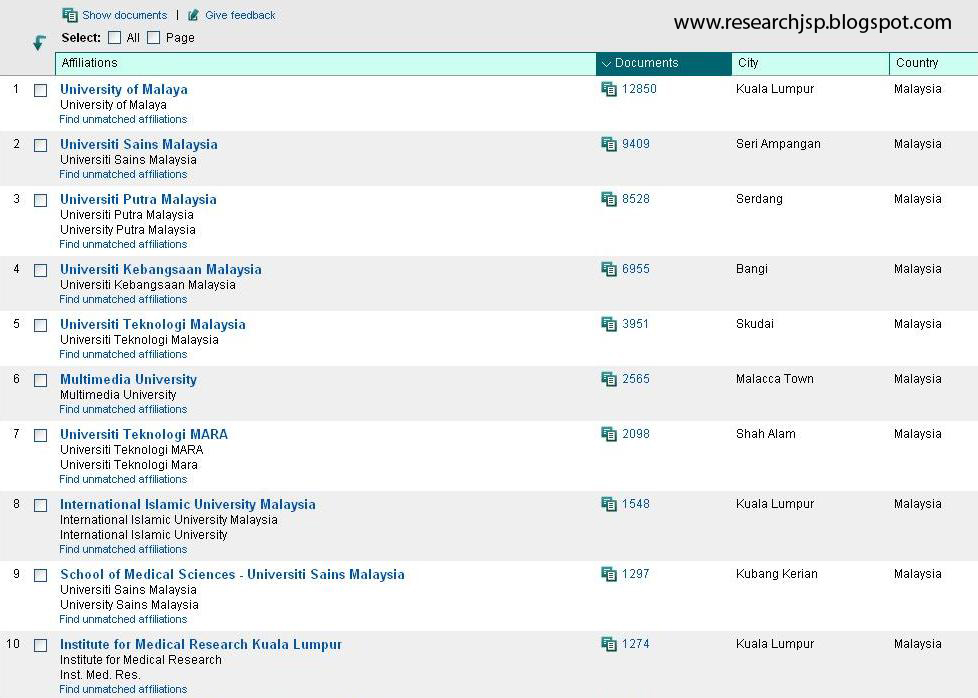
Malaysian universities' publication indexed by SCOPUS in January 2011

**Click image for FULL view**

SCOPUS is the largest abstract and citation database of peer-reviewed literature and quality web sources. It has smart tools to track,analyze and visualize research and integrates seamlessly into researchers`workflow.

Ranking University on May 2010: HERE

Citation Analysis part#3

A high volume of self-citation is not unusual or unwarranted in journals that are leaders in a field because of the consistently high quality of the papers they publish, and or because of the uniqueness or novelty of their subject matter. Ideally, authors reference the prior publications that are most relevant to their current results, independently of the source journal in which the work was published.

However, there are journals where the observed rate of self-citation is a dominant influence in the total level of citation. For these journals, self-citation has the potential to distort the true role of the tittle as a participant in the literature of its subject.

Eighty per cent of all journals listed in the JCR Science Edition have self-citation rates less than or equal to 20%. This shows that self citation is quite normal for most journals and id expected.

Significant deviation from this normal rate, however, prompts an examination by Thomson Reuters to determine if excessive self-citations are being used improperly, the journal's Impact Factor (IF) will not be published and the journal may be considered for deselection from the Web of Science.

Citation Analysis

The Thomson Reuters evaluation process is unique in that our editors have a wealth of citation data available to them. The importance of interpreting and understanding these data correctly cannot be emphasized too strongly. using quantitative citation data to measure impact is meaningful only in the context of journals in the same general discipline.


For example, smaller fields like crystallography do not generate as many articles or citations as do larger fields such as biotechnology or genetics. Likewise, in some areas, particularly in the arts and humanities, it may take a relatively long time for an article to attract a meaningful number of citations.


But in other areas, such as the life sciences, it is not unusual for citations to accrue rapidly and peak after two or three years. These facts must be taken into consideration if citation data are to be used correctly.

International Diversity

Thomson Reuters editors look for International Diversity among the contributing authors and the journal's editors and Editorial Advisory Board members. This is particularly important in journals targeting an international audience. Today's scientific research takes place in a global context and an internationally diverse journal is more likely to have importance in the international community of researchers.


As the global distribution of Web of Science expands into virtually every region on earth, the importance of regional scholarship to our emerging regional user community also grows. Selection criteria for regional journals are the same as for international journals although citation analyses play a somewhat different role in the outcome.


For example, the importance of the regional journal would be measured more in terms of the specificity of its content. Will it enrich our coverage of a particular subject or provide studies with a specific regional perspective?


Many excellent regional journals target a local rather than an international audience. therefore, the emphasis on extensive international diversity is less than for internationally focused journals.


All regional journals selected must be publishing on time, have English- language bibliographic information (title, abstract, keywords) and be peer reviewed. Cited references must be in the Roman alphabet.

What is Journal Selection Process? part#2

Continue from this posting


**********************************

The Evaluation Process


Journal evaluation and selection is ongoing at Thomson Reuters with journals added to and deleted from the database as frequently as every two weeks. Each year, Thomson Reuter`s editorial staff reviews over 2,000 journal titles, and selects around 10-12% of the journals evaluated for inclusion in the database.


Moreover, existing journal coverage in Thomson Reuters products is constantly under review. Journals now covered are monitored to ensure that they are maintaining high standards and a clear relevance to the products in which they are covered.


The journal selection process described here is applied to all journals in Web of Science, whether covered in Science Citation Index Expanded, Social Sciences Citation Index, or Arts & Humanities Citation Index. Some special consideration is given in the evaluation of social science and arts & humanities journals, particularly with regard to citation analysis.


Many factors are taken into account when evaluating journals for coverage, ranging from the qualitative to the quantitative. The journal`s basic publishing standards, its editorial content, the international diversity of its authorship, and the citation data associated in isolation,but by combining and interrelating the data, the editor is able to determine the journal`s overall strengths and weaknesses.


Thomson Reuters editors performing journal evaluations have educational backgrounds relevant to their areas of responsibility as well as experience and education in information science

Ranking University in SCOPUS


** Rank by SCOPUS


SCOPUS is the largest abstract and citation database of peer-reviewed literature and quality web sources. It has smart tools to track,analyze and visualize research and integrates seamlessly into researchers` workflow.

What is SCOPUS??

Scopus is the largest abstract and citation database of research literature and quality web sources. It's designed to find the information scientists need. Quick, easy and comprehensive, Scopus provides superior support of the literature research process. Updated daily, Scopus offers.


•Nearly 18,000 peer-reviewed journals from more than 5,000 publishers, including coverage of.

•16,500 peer-reviewed journals (inc > 1200 Open Access journals)

•600 trade publications

•350 book series

•Extensive conference coverage (3,6 million conference papers)

•38 million records, of which

•19 million records include references going back to 1996 (78% include references)

•19 million pre-1996 records go back as far as 1823

•Results from 435 million scientific web pages

•23 million patent records from 5 patent offices

•"Articles-in-Press" from over 3,000 journals

•Seamless links to full-text articles and other library resources

•Innovative tools that give an at-a-glance overview of search results and refine them to the most relevant hits

•Alerts to keep you up-to-date on new articles matching your search query, or by favorite author


Scopus is the easiest way to get to relevant content fast. Tools to sort, refine and quickly identify results help you focus on the outcome of your work. You can spend less time mastering databases and more time on research.